Lipstick Plants
Epiphytes or "Air Plants" grow on other plants, frequently large trees, although they are not parasites. Their roots do not penetrate the host tree, they merely use its surface for support. In the forest canopy, epiphytes do not have to compete for space with plants that root on the ground. They are, however, limited by the availability of water and nutrients, and for this reason mostly grow in wet montane and cool cloud forests.
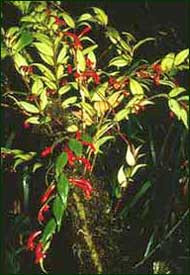
Among the more spectacular epiphytes are the lipstick plants (Aeschynanthus), so named because of their very bright, flamboyant red flowers. Horticulturists and gardeners have been inventive in naming various species of this group of vines—from the riotous "royal red bugler" and "scarlet basket vine" to the demure and modest "blush wort" and "climbing beauty." Lipstick plants are members of the African violet and gloxinia family, known for its many popular cultivated ornamentals.
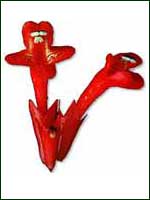
With more than 100 species in Asia, the lipstick plants are represented in the Philippines number at least 25 species, presumably all endemic to the country. They are sometimes encountered in damp primary forests at low elevations, but become more numerous in high mossy forests. Incontrast to the many woody climbers in the forest, the delicate, herbaceous, vines of lipstick plants twist softly around tree branches. In addition to their brilliant, flame-red tubular flowers, these beautiful epiphytes are conspicuous for their fleshy, bright green leaves. The flower tubes often resemble exaggerated lips, the broad lower lip providing a suitable landing platform for insect pollinators, particularly bees attracted to brilliant red colors. Four stamens protrude from the mouth of the flower tube. As bees enter the mouth of the tube in search of the sweet nectar at its base, they collect pollen on their backs. Each bee will carry thousands of pollen grains to the next flower it visits, fertilizing a great number of ovules that eventually turn into seeds. Ants nesting on tree trunks and limbs presumably carry thousands of these tiny seeds to their hidden abodes where they will germinate to form new plants.
Lipstick plants and other herbaceous plants in the understory are especially susceptible to the removal of trees that shelter them from the bright sun. We know very little about the reproductive biology of these plants; their demise will be a serious loss to science and to the horticulture industry, which depends on such knowledge to develop successful cultivation and breeding methods.
Original URL: http://archive.fieldmuseum.org/vanishing_treasures/V_Lipstick.htm