Screw Pines and Climbing Pandans
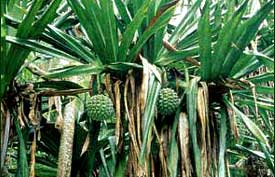
The screw pines (Pandanus), so named for the peculiar spiral arrangement of their elongated, spiny leaves, grow on cliffs, sandy shores, and in beach forests. They can also grow in primary forests in the mountains up to 1,500 meters elevation. The Philippine species vary from small shrubs less than a meter tall to trees reaching 15 or more meters.
"Screw pine" also refers to the large, pineapple-like fruits of the more common and widely distributed species. Most of the Philippine species have prominent prop roots, structures that emanate from the trunk and reach to the ground like stilts, thus supporting the whole plant. There are nearly 50 species of screw pines in the Philippines, many which are strictly localized.
One species, Pandanus amaryllifolius, has fragrant leaves that Filipinos use to flavor rice and other dishes. Since the leaves of screw pines are fibrous, resistant to decay, and grow very long, they are widely used in baskets, bags, hats, and mats. In the Bicol region, a species known to the Bicolanos as karagomoi (Pandanus simplex) is cultivated and used for basketry.
The climbing pandans (Freycinetia) are very conspicuous and attractive when in bloom. The male and female flowers, which grow on separate plants, are tightly packed in cylindrical structures called cones. The brilliant cones grow in clusters of three, surrounded by whorls of fleshy, reddish-orangebracts, then by long, slender, pointed leaves. The fragrant and fleshy bracts (specialized leaves supporting the flowers) are eaten by the harpy fruit bat (Harpyionyteris whiteheadi) whose whiskers and fur collect pollen from male flowers, which rubs off on the female flowers the animals visits later.
Original URL: http://archive.fieldmuseum.org/vanishing_treasures/V_SPine.htm