Philippine Lizards
Most people growing up in the Philippines grow up with lizards. Among the first wild animals seen by many children are the small house geckoes that emerge each evening. They cling upside down to the ceiling snapping up insects that are attracted to lights. Their barking calls are often the last sounds that children hear as they drift off to sleep.
These house geckoes are members of a family that includes at least 35 species in the Philippines, most of which live only in forest. Their amazing ability to hang upside down is due to lengthened fingers and expanded scales on both fore- and hind-feet; the scales are able to catch tiny projections from wood or painted surfaces, providing enough purchase to support their thin bodies. In a few species that live in forested areas, the enlarged feet have expanded even more, to the point that the lizards are able to use them as glider wings and sail from tree totree. A group of lizards in a different family can spread their rib cages enormously to the sides, giving them the ability to "fly" as well.
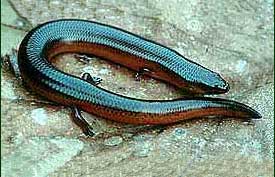
There are altogether about 125 species of lizards in the Philippines, with about 99 unique to the country. I addition to the many kinds of geckoes and members of several less diverse groups, there are at least 65 species of skinks. The skinks are among the most active and conspicuous animals on and near the ground in lowland forest during the daytime, noisily rustling through fallen leaves as they search for insects to eat. Several especially small skinks live beneath rocks; their legs are so tiny that they can barely be seen, and the lizards move by wriggling. (We have sometimes briefly mistaken them for earthworms.) Some other species live in cool, wet mossy forest; we have seem them only during the rather rare warm and sunny periods, basking on a branch before the fog rollsin.
Little is known in detail about the lives and ecology of most species of Philippine reptiles, and , as with frogs, a great many new species are currently being discovered—at least ten in the last five years. The limits of our information also make it difficult to know how many are endangered. We do know, though, that the majority of the more than 165 species of unique reptiles (including snakes, turtles, and lizards) require old-growth forest for their survival, and that many species are known to live only on one or a few islands. These two facts make it likely that a significant number of species are endangered by habitat destruction, but just how many remains for field biologists to determine.
Original URL: http://archive.fieldmuseum.org/vanishing_treasures/V_Lizard.htm