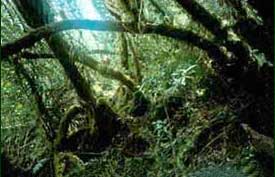
The forest on Mount Isarog in southern Luzon where we captured the animal in May 1998 is one of the most remarkable places on earth. Orchids grow everywhere, and earthworms are so abundant that their cast-off piles of dirt nearly cover the ground. The small trees with twisted, gnarly trunks and branches are so densely covered with moss that what we thought were tree trunks often proved to be stems no thicker than a thumb surrounded by several inches of moss. This moss blankets even the ground, at the top of a layer of humus two to five meters thick. Fog blows through the trees during most of the day and night, leaving everything dripping with water, and torrential rains fall frequently during most months; the total yearly rainfall can reach 12 meters, more than 12 times as much as in Seattle. Temperatures are low, never freezing but rarely warm. The diversity of plants in the habitat is stunning: On one afternoon, I counted two species of orchids, at least three kinds of ferns, two species of club-mosses,five species of mosses, and five species of saplings growing on a log only a third of a meter long.
In April 1961, a team of field workers from Silliman University, led by Professor Dioscoro S. Rabor, had conducted the first zoological studies of Mount Isarog National Park, as part of a long-term study of birds in collaboration with several museums in the United States. In what little time could be freed from the bird studies, they set traps for small mammals, since the local species had never been surveyed previously. Professor Rabor, better known as Joe, had promised to send some rodents back to the Field Museum of Natural History in Chicago, to a friend and colleague who had a special interest in Philippine rodents. The team caught more than one hundred species of birds, but had time for only a little trapping; about two dozen small rats and mice were quickly skinned and stuffed for the museum before anyone had time to examine them closely. No notes were made describing the habitat or the odd appearance of several of theanimals.
The rodent specimens were cleaned and cataloged in Chicago but sat in a cabinet unstudied, for Joe Rabor's friend, "Sandy" Sanborn, was in declining health, and died not long after. It was not until 20 years later that two other biologists saw the specimens and realized that among them were two species of mammals completely unknown to science, each represented by a single specimen—a tiny shrew-like species and a rodent with big haunches and an exceptionally elongated snout. The biologists named the larger of the two speciesRhynchomys isarogensis, which translates as "the snout-mouse from Isarog." |
|
|