Islands Rising 2
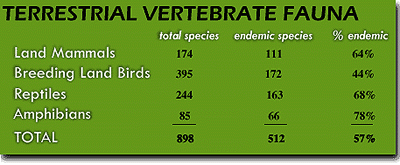
This history of geological isolation and gradual approach to the Asian mainland has had an enormous impact on the country's biological diversity. Birds, bats, butterflies, and other flying animals and wind-dispersed plants were able, in many cases, to surmount the difficulties of crossing broad water channels, but even for these creatures it was a rare and treacherous journey. Travel from the Asian mainland to the Philippines was so infrequent that 172 out of 395 (44 percent) of the land-birds present are found only in the Philippines. This genetic isolation could not have taken place if even a single individual of the ancestral population had flown in from the mainland just once per generation. Among Philippine mammals that cannot fly, an amazingly high 85 percent (86 out of 101) live only in the Philippines. Many of the species that did manage to undertake the difficult journey have undergone the same kind of astounding diversification that most people associate with the Galapagos and Hawaiian Islands—a single ancestor giving rise to five, ten, or 25 descendent species, allhaving arisen within the Philippines. In fact, as a gauge of biological diversity, it is reasonable to think of the Philippines as the Galapagos Islands multiplied tenfold. We now estimate that more than 510 species of land-living mammals, birds, reptiles, and amphibians exist only in the Philippines. As a point of comparison, only seven of the 30 countries in Europe have any unique species of these groups, and the one with the highest number, Spain, has only 25 in total. Brazil, often referred to as the "storehouse of biological diversity," has about 725 unique species, about one-half more than the Philippines—but Brazil is 28 times larger. Madagascar, which is famous for its biological diversity, has fewer species of unique mammals than the Philippines (about 90 versus 111), despite the fact that Madagascar has twice the land area of the Philippines. Madagascar has the unique and remarkable lemurs that attract much attention, but the Philippines can boast of the Philippine eagle (second largest eagle in the world), the dwarf water buffalo of Mindoro, spectacular orchids, flying lemurs, huge hornbills, and many other extraordinary species.
Original URL: http://archive.fieldmuseum.org/vanishing_treasures/Discover_3a.htm