Negros Island, pt 2
A Case Study in Deforestation, pt 2
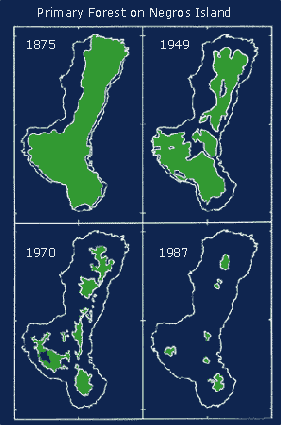
From 500,000 in 1898, the population of Negros climbed to nearly 2,000,000 in 1970 and to about 3,000,000 today, at a density of 220 per square kilometer, which is twice that of France and nearly eight times that of the United States. Old-growth forest cover declined from 90 percent in the 1700s to about 60 percent at the end of World War II. The continued expansion of sugar-cane fields onto hillsides during the 1950s and 1960s was made possible by United States government subsidies to the sugar industry. These subsidies were initially intended to stimulate an economy weakened by World War II, and later to prop up a friendly government during the U.S. war in Vietnam. Unfortunately, an unintended side-effect of the subsidies was to encourage the plantation owners maintain their old, inefficient hand-labor system. The subsidies also made it economically feasible to clear and farm steep, easily eroded hillsides and turn a tidy profit; without thesubsidies, these hillsides would have been left alone. The last remnants of the old-growth rain forest below 850 meters (3,000 feet) were cleared by the mid-1970s, and the cycle of human poverty and population growth was maintained for another generation. An ever-increasing numbers of workers left the plantations in search of land to farm on the slopes of the mountains.
During the period that the Philippines was an American colony, rain forest were cleared for commercial purposes: Logging rapidly extracted profits for American companies and allowed for the expansion of plantations. After World War II, when the Philippines became independent,logging increased at a greater rate under combined foreign and Filipino ownership. While the owners of the logging firms reaped large profits, wages were too low to allow workers to break out ofpoverty, and the roads built by the loggers opened ever-larger areas to easy access by landless farmers. Taxes on logging that might have paid for reforestation, rural development, education, or other services were kept very low, so that few benefits flowed to the local inhabitants. During the 20-year administration of Ferdinand Marcos, logging concessions were given to his supporters and allies; 25-year concessions for up to 100,000 hectares often were sold for a fee of one peso per hectare (about ten cents per acre); taxes averaged 30 pesos for a cubic meter of logs valued at an average of 2,800 pesos. Ultimately, under this arrangement, the poor and the middle class subsidized the rich by bearing the costs of floods, droughts, erosion, siltation, and lack of education. Corruption came to be a large factor in logging; many logging companies were owned by politicians who sought to maximize their own profits by keeping taxes unreasonably low (and actual payments lower still), while ignoring the needs of the people in the regions they represented. On Negros, old-growth forest declinedto about eight percent in the mid-1970s, to six percent by 1984, and to less than four percent in 1992. Today, this forest exists as tiny patches of montane and mossy rain forest near the tops of the mountains; old-growth lowland forest exists only as a few thin ribbons between the montane forest and the cleared lowlands. These patches and ribbons of forest now function as small islands of natural rain-forest habitat surrounded by a sea of impoverished people.
Part 3: http://philippines-dev.fieldmuseum.org/natural-history/narrative/4800