Negros Island Today
Although there are several small cities on Negros Island where industry and commerce thrive and where the economy is improving, the population of the island today is predominantly rural and poor. The coast is a heavily populated strip, with large numbers of people who are primarily subsistence fisherfolk; although they may do some farming and other work, they make their living primarily from what they can catch in the sea. In recent years this has become increasingly difficult, both because their numbers have swollen and because commercial boats, often from other countries, have taken an increasingly greater portion of the catch. Dynamite fishing, clearing of mangrove forest that provides the nursery for young fish of many species, removal of corals for building material and decoration, and pollution and siltation from the land have all diminished the capacity of the reefs to produce, with thecumulative threats to marine ecosystems equaling those on land.
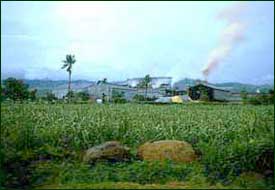
Inland from the coast in most places is the richest land, the fertile lowlands of weathered volcanic soil that produces bumper crops of sugar cane. Although this land is the richest and most productive for agriculture, it is remarkably thinly populated; most of the land is covered not by crops for local consumption, and not by small farms owned by the people who till the land, but by large haciendas owned by just a few people, producing a crop that is exported. Nearly all farm work is still done by hand, and wages for unskilled workers remain very low. Because the global price for sugar has dropped, pressure to keep wages low is strong. In recent years, the landowners have shifted their efforts to producing prawns for export to Japan, often destroying the last ofthe mangrove swamps to dig the ponds in which the prawns are raised. Because no new money is invested in the sugar cane business, it is becoming more and more inefficient, with small processing plants more than 50 years old belching smoke over the countryside as the sugar is extracted from the cane.
Further inland from the cane fields are large tracts of coconut plantations, where coconuts are harvested for production of copra, which is dried coconut used to produce oil and some other products. Huge areas were planted when the global price was high for several decades after World War II, with a few landowners making large profits, but now that the price has dropped, the crop barely pays for its harvesting. Cattle and water buffalo graze beneath the coconuts, adding a bit to the economic value of the land. This land is more densely populated than the lowlandagricultural lands, with some small farmers growing crops for local sale.
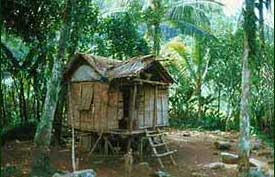
Still further inland, on the slopes of the mountains that have soil too poor for sugar cane or too isolated for coconut plantations, is one of the most densely inhabited parts of the island. At least 30 percent of the population lives in these upland areas, often making their clearings in second-growth forest left by logging operations in the 1970s and 1980s. Although neighbors respect each other's rights to the land they farm, they occupy the land illegally and live in constant fear of being forced from their only source of livelihood. They are called kaingineros,people who make slash-and-burn clearings, but they are generally unable to shift from one spot to another, as was done traditionally, for there is often no place to which they may move. Most families live in huts made of thin planks and bamboo, more than a kilometer from the nearest road and often hundreds of meters from a stream that provides the only water. They are almost always impoverished,making only a few hundred dollars or less per year. The young men often labor in the cane fields or coconut plantations when there is work, or cut any trees that remain and haul the timbers behind a water buffalo to the nearest road for sale to a local businessman—often, in our experience, a close relative of a prominent local politician. Opportunities for education are seriously inadequate, and health care is distant and, for these people, often unreachably expensive. Birth rates in this portion of the population are the highest for the nation, with an average family size over six and a growth rate of 2.8 percent per year ormore.
As the children mature, it is rare for them to have a livelihood open to them other than to marry as soon as possible—for one person alone can do almost nothing—and move to the edge of the forest, either on Negros or on another island, where they clear and burn a patch of farmland still higher on the mountain. On Negros, new farms are now cleared in areas well over 1,000 meters elevation where rainfall exceeds three meters per year and where the slope of the farmed land often exceeds 45 degrees and rarely drops under 20 degrees. When we talk with these farmers, they often say that they would prefer that no one move upslope from them because of the floods, erosion, and drought that will follow, but more than anything else they respect the need of their neighbors to survive. As more people move upslope, those below them become more impoverished by the declining productivity of theirland, and eventually have little choice but to move still higher on the mountain or to another island, perpetuating the cycle. The land the kaingineros leave behind is soon covered only by tough, nearly useless sawgrass, which prospers in the fires that sweep across the hills as farmers clear their fields during each dry season. On Negros, as in most parts of the Philippines, 20 percent to 30 percent of the land is now covered by sawgrass—easily eroded and productive only for limited grazing for a few weeks each year.
At the time of this writing in late 1997, landless farmers continue to creep higher up the slopes into the little patches of remaining high-elevation rain forest on Negros; the unpopulated land that remains is steep, cold, and rainy, but may suffice for a few years for people who seekonly survival. Many people emigrate to Mindanao and Palawan, but it is our subjective impression that emigration is lower than the birth rate, and density continues to increase. It is the intense pressure from such people that now poses the greatest single threat to the survival of biodiversity on the island. Unless there are socioeconomic changes that alter the cycle of poverty, destruction of the last forest looms within the next decade.