The Biological Costs 2
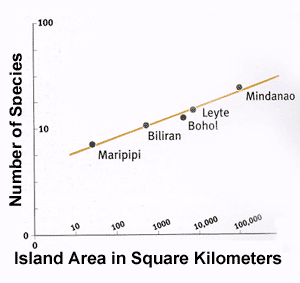
When we plot the number of species against the area of the island for the six islands, it is clear that there is a remarkably strong correlation between area and number of species. In spite of their common biological and geological history and the generally identical nature of their faunas, the smaller islands have fewer species—and the smaller the island, the smaller the number of species. The message is unmistakable: After the rising sea water at the end of the Ice Ages broke apart the islands and changed them from mountains or hills on Greater Mindanao to isolated islands, many species were unable to survive as the islands shrank. Extinction, in this case natural extinction, took place because of shrinking populations. Analysis of our data on the ecology of the animals shows that those most vulnerable to extinction were the species that naturally exist at low densities, those that occurred only in one habitat, and those that are especially unable to tolerate any habitat other than undisturbed old-growth forest.
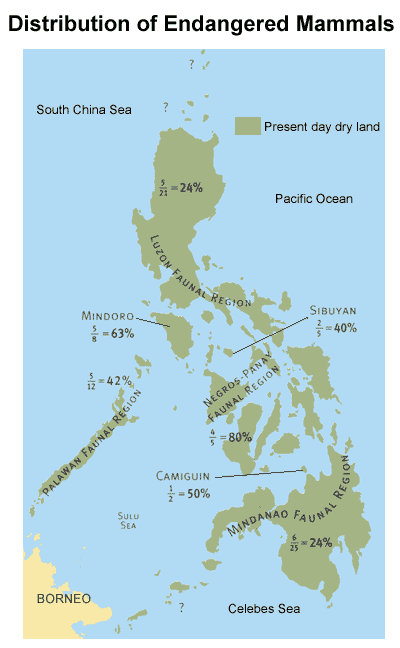
Look again at the map of current forest cover of the Philippines. The natural habitat on most islands has been reduced, but it has also been divided into tiny islands of forest habitat isolated from other patches by a sea of humans. Our studies of mammals on the islands of Greater Mindanao leads us to predict that the mammals (and other species) in these forest patches are now vulnerable to extinction due to the shrinking of their habitat. Studies of mammal species in forest reserves in the United States, East Africa, and elsewhere tell us that this prediction is almost certainly correct. The correlation between the percentage of endangered species and the amount of forest cover makes the prediction virtually certain. As the rain forests of the Philippines shrink, more and more species are being stressed to the point of extinction by lack of habitat and tiny population size.
The less rain forest that remains in a given region, the greater the proportion of endangered species.
There are dozens of examples. On Mindoro, where only eight percent of the original rain forest was left in 1992, we see the tamaraw, a shrew, three unusual rodent species, and at least two fruit bats listed in the 1997 Philippine Red Data Book among those critically threatened. On Negros, where primary forest cover is down to less than four percent, we see the severely endangered Visayan spotted deer, with perhaps no more than 200 left in the wild, and the Philippine tube-nosed fruit bat probably down to one percent of its original population, barely surviving in a narrow band of lowland forest around a few mountain peaks, with illegal logging and clearing for subsistence farms cutting that forest band ever thinner. In some cases, the damage is greater, sadly definitive, and irreversible. The Philippine bare-backed bat is extinct, one of the first species to test, and verify, the horrible prediction of impending extinction for one-third to two-thirds of the speciesof mammals unique to the Philippines.
The picture for birds is similarly bleak. Of the 172 species of birds that are unique to the Philippines, 75 are listed as endangered. All but one of the 172 endemic species, and all of the 75 endangered species, are dependent on forest for their survival, and many on undisturbed rain forest. The Philippines is the only country in the world to be entirely covered by the Endemic Bird Areas (EBAs) recognized by Birdlife International. Three of these EBAs in the central Philippines are among the ten highest priority conservation areas for birds worldwide. The Philippines is third highest in the world (after Indonesia and Brazil, which are more than 20 times larger) for the number of globally threatened bird species, and is first in the world for the number (40) of endangered and critically endangered unique bird species. Again we see clear evidence that the number and proportion of birdspecies that are threatened correlates with the amount of destruction of old-growth forest that has occurred within each region. Cebu, for example, which is the most thoroughly deforested island in the country—it has almost no native vegetation remaining—had 14 species and subspecies of birds that are found nowhere else in the world. Three of these are now extinct, and all but one of those still living are believed to be represented by fewer than 100 individuals in the entire population. One of these, the exquisite Cebu flowerpecker, is the most endangered species of bird in the world, with only four individuals known to be alive. The destruction of rain forest habitat may have doomed these birds, just as it has caused Cebu City, the second largest city in the Philippines, to ration water and to suffer increasingly from saltwater contamination of wells because of the vast decline in rainwater entering the groundwater system.
Birds and mammals are the best-known groups of organisms in the world; for the others, so little is known that global comparison of numbers of endangered species is not possible. However, as the Philippine Red Data Book published in 1997 demonstrates, there are endangered reptiles, amphibians, and butterflies in many parts of the Philippines, and a wide range of sources document the ever-increasing numbers of plant species endangered by habitat destruction and over-harvesting.
Taken together, these data form the basis for Conservation International's recent description of the Philippines as having the most severely endangered plant and animal communities on earth. Other, much larger countries may have more endangered species and patches of forest, but nowhere are the problems more intense and proportionately more significant.